


Found in the Field
Selenite Gypsum Crystal Specimen — Natural Tabular Crystals, Clear to White, 971g (2.14 lb) — Field Find
Selenite Gypsum Crystal Specimen — Natural Tabular Crystals, Clear to White, 971g (2.14 lb) — Field Find
Couldn't load pickup availability
THE FIND
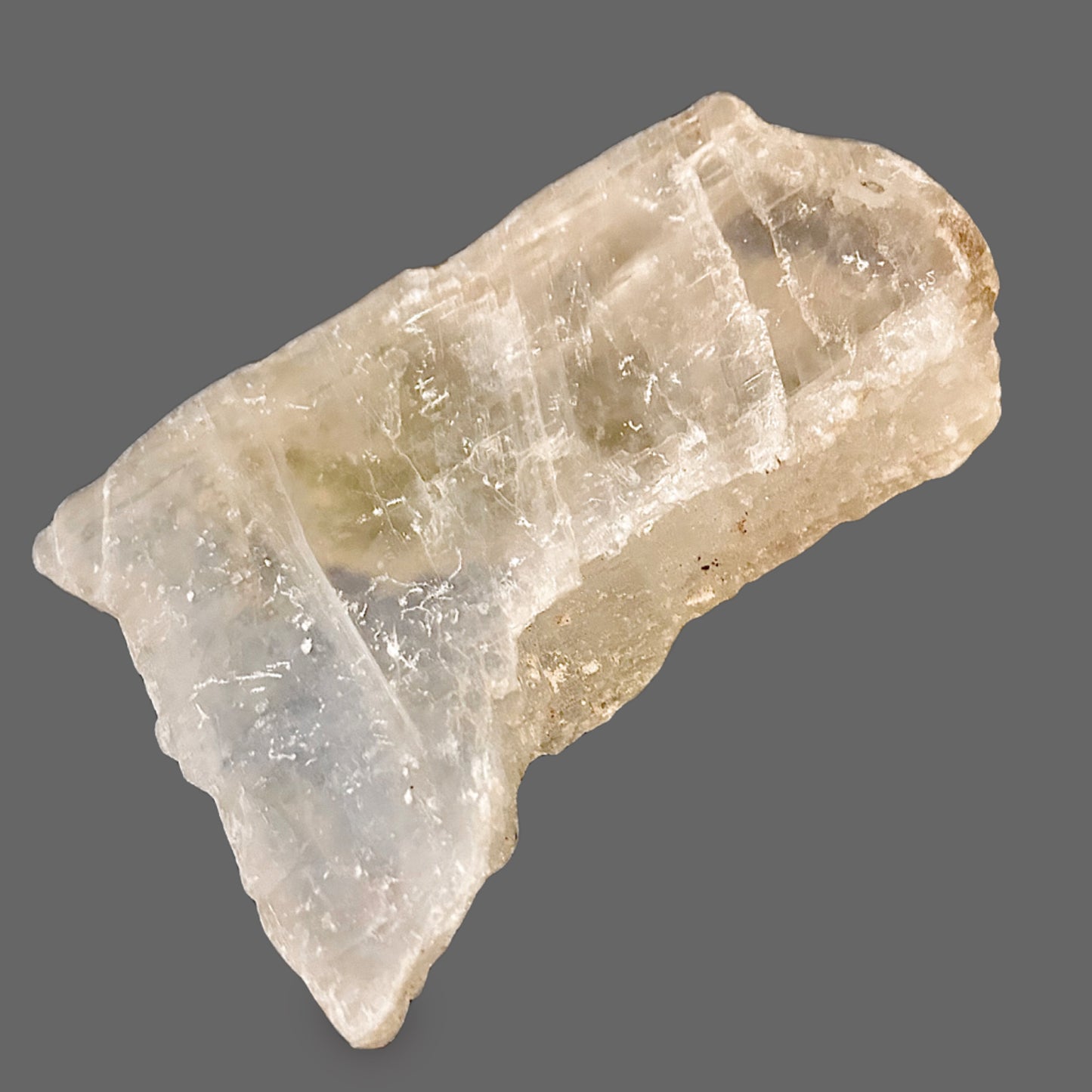
A selenite gypsum crystal specimen, 971g (2.14 lb) — natural tabular gypsum crystals with flat cleavage faces, clear to white, with the soft luminous quality that makes selenite one of the most immediately recognizable minerals in any collection. Some stones don’t need brilliant color to command attention. This one catches light across its cleavage surfaces, revealing the quiet, glassy character that gypsum develops when it forms large clear crystals. At nearly two and a quarter pounds, it has enough presence to become a genuine display piece.
WHAT WE KNOW
Selenite is the clear to translucent crystalline variety of gypsum — calcium sulfate dihydrate (CaSO₄·2H₂O) — distinguished by its well-developed flat cleavage faces, vitreous to pearly luster, and transparency in larger crystals. It is soft (Mohs 2 — can be scratched with a fingernail) and has perfect cleavage in one direction. The name selenite derives from the Greek selene (moon), referencing the pearly, moonlike luster of the cleavage faces. Gypsum is a common evaporite mineral that forms in sedimentary environments where saline water evaporates and leaves behind dissolved calcium and sulfate ions. Large selenite crystals can form in caves (the Cave of Crystals in Chihuahua, Mexico contains selenite crystals up to 11 meters long), in desert evaporite deposits, and in hydrothermal veins. Note: many specimens sold in the mineral trade as “selenite” are actually satin spar — the fibrous variety of gypsum with a silky rather than glassy luster. This specimen shows flat cleavage faces and vitreous luster consistent with true selenite rather than satin spar. The exact geological locality has not been independently verified. Weight: 971g / 2.14 lb.
THE STORY
The name is from the moon. Selenite was named for the way its cleavage surfaces catch light — a soft, luminous reflection that early mineralogists found lunar in quality. The mineral itself is built from layers: gypsum crystallizes in flat tabular forms, and the cleavage that gives selenite its characteristic faces is a direct expression of the layered crystal structure. The largest selenite crystals ever found — in a flooded cave in Mexico — grew for approximately 500,000 years in hot, mineral-saturated water in complete darkness. These are considerably smaller. But the chemistry is the same.
WHY WE CHOSE IT
The scale and the clarity together make this specimen. At 971g selenite has real physical presence, and the flat cleavage faces produce the luminous surface quality that makes the material worth displaying. Works equally well as a mineral specimen, a natural display object, or as part of a crystal collection. Note: gypsum is soft (Mohs 2) — handle with care and keep away from harder objects that could scratch the surface.
ABOUT THIS PIECE
Type: Selenite gypsum crystal specimen (clear tabular gypsum; visual identification as selenite rather than satin spar based on cleavage face character; locality not independently verified)
Weight: 971g / 2.14 lb
Hardness: Mohs 2 — handle with care, scratches easily
Locality: Not independently verified
Condition: Natural crystal specimen — please review photographs for cleavage face character, translucency, surface, and natural variation.
Quantity: 1 — one of a kind.
Share


Field Notes
Recovered and preserved as discovered.
Marks, textures, and imperfections remain untouched.