


Found in the Field
Polished Agate Geode — Wild Swirling Banding, Druzy Crystal Cavity, Red & Blue-Grey — Field Find
Polished Agate Geode — Wild Swirling Banding, Druzy Crystal Cavity, Red & Blue-Grey — Field Find
Couldn't load pickup availability
THE FIND
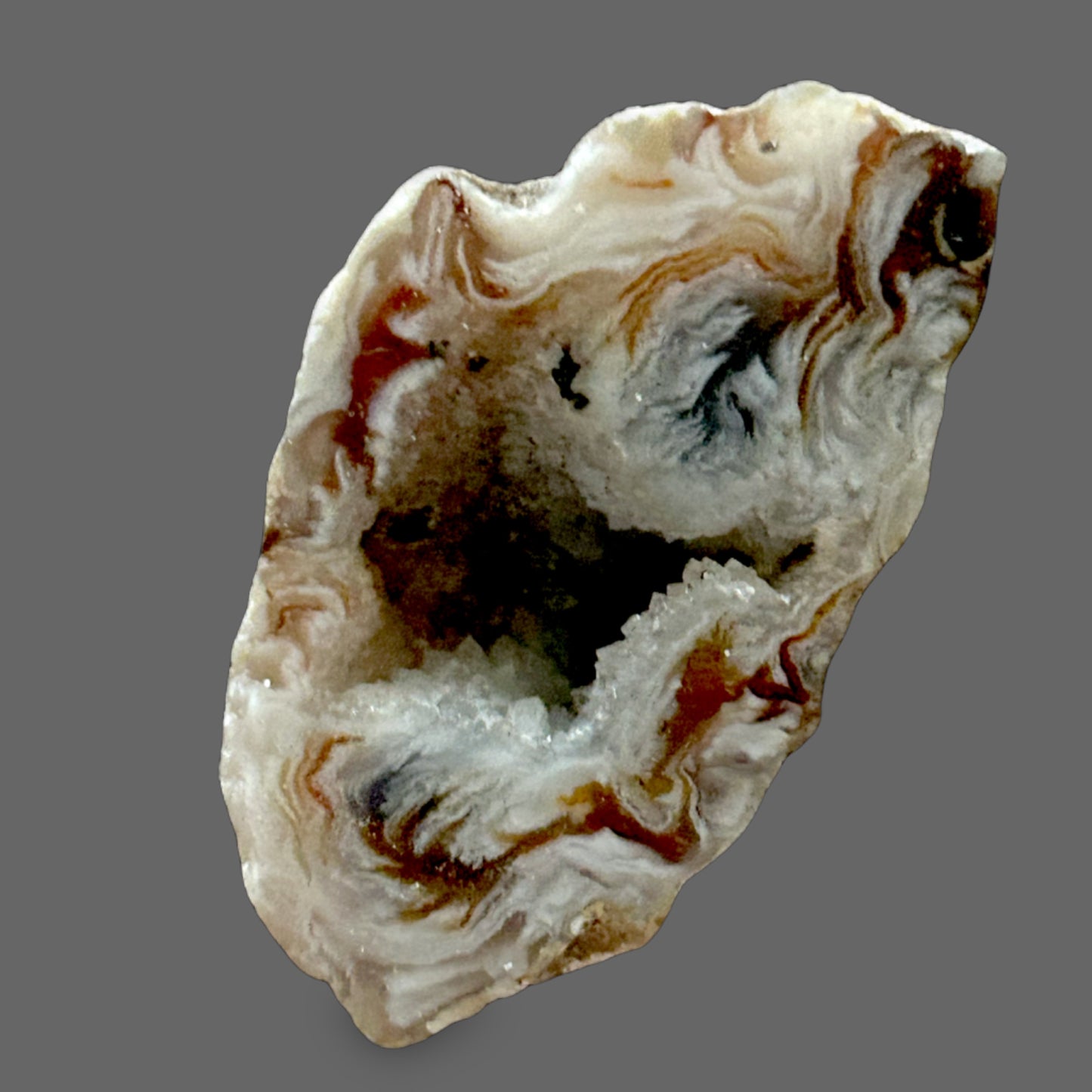
A polished agate geode freeform — extraordinary swirling banded agate with fluid red-orange, cream, blue-grey, and white layers moving across the face in turbulent, almost painted arcs, with a small open druzy quartz crystal cavity at the center. From the outside, there is little warning. Then the interior catches the light. This is not concentric ring agate. The bands in this specimen move like weather — curved, flowing, crossing one another in ways that are difficult to look away from.
WHAT WE KNOW
This is a polished agate freeform with an open geode cavity — a natural specimen that has been cut to reveal the interior face and polished to bring out the banding detail. Agate is banded chalcedony — microcrystalline quartz (SiO₂) — in which successive layers of silica-rich fluid deposit on the interior walls of a rock cavity over geological time. The classic concentric ring pattern of agate develops when deposition is uniform; the turbulent, swirling banding visible in this specimen develops when fluid flow and deposition conditions within the cavity were irregular, changing direction and pressure during formation. This style of non-concentric, fluid-flow banding is associated with what collectors call wild agate or landscape agate — material in which the banding records complex, irregular fluid dynamics rather than simple layered deposition. The red-orange color is from iron oxide (hematite/goethite), the blue-grey from manganese oxide or inclusion-bearing silica, and the cream from relatively pure chalcedony. The small open cavity at the center is the geode element: the space where the available silica was exhausted before the cavity was fully filled, leaving a pocket lined with small druzy quartz crystals. The exact geological locality has not been independently verified. Weight: [CONFIRM — please weigh and update].
THE STORY
Most agate builds itself in orderly rings — each band the record of one depositional phase, concentric and legible. This specimen didn’t. The fluid that carried the silica moved through this cavity under conditions that kept changing — direction, pressure, chemistry, timing. Each band is a record of a different moment in that process, laid down in a different direction, at a different rate, carrying a different mineral load. The result is something that looks less like geology and more like motion caught in stone. The open crystal cavity at the center is where the story ended: the silica ran out, and what remained of the space filled with quartz crystals instead.
WHY WE CHOSE IT
The banding on this specimen is exceptional — the fluid, turbulent movement of the red-orange and blue-grey layers across the cream ground is the kind of natural patterning that makes agate collectors stop mid-sentence. Displayed on a stone block stand (visible in photographs — please confirm whether included). One of the strongest visual specimens in the Found in the Field catalog. Worth reviewing the price against comparable wild agate freeforms before publishing.
ABOUT THIS PIECE
Type: Polished agate geode freeform (wild/turbulent banded chalcedony with open druzy quartz cavity — locality not independently verified)
Weight: [CONFIRM — please weigh and update]
Display stand: Shown in photographs — please confirm whether included
Locality: Not independently verified
Condition: Polished face, natural edges — please review photographs for banding pattern, color, cavity, and natural variation.
Quantity: 1 — one of a kind.
Share


Field Notes
Recovered and preserved as discovered.
Marks, textures, and imperfections remain untouched.