


Found in the Field
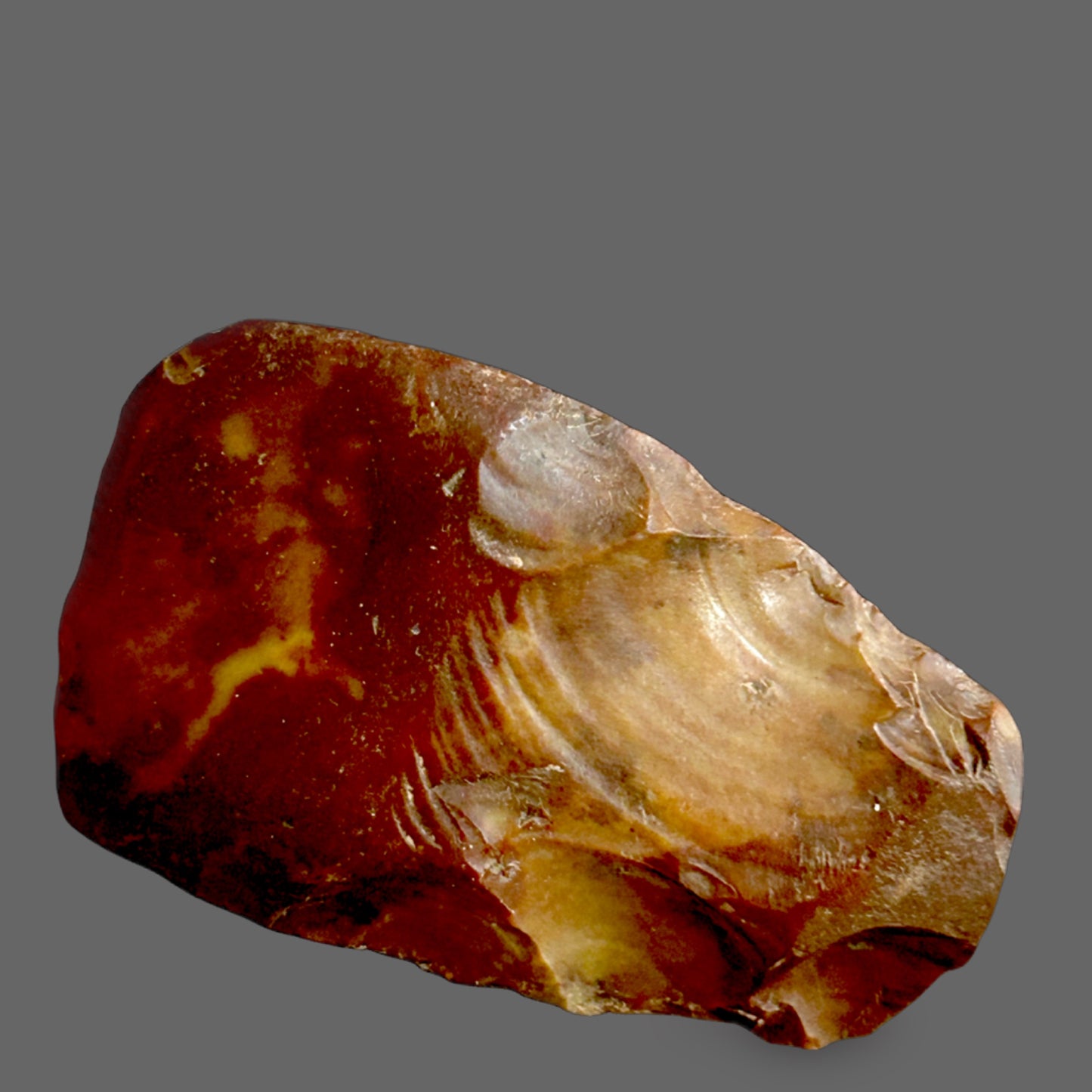
Palaeolithic-Style Handaxe — Knapped Flint Stone Tool, 12g — Field Find
Palaeolithic-Style Handaxe — Knapped Flint Stone Tool, 12g — Field Find
Couldn't load pickup availability
THE FIND
A knapped flint handaxe, 12g — stone worked against stone, edge by careful edge. It fits the hand like it was made for it. Someone held this before you. There is something grounding about holding an object that may be this old. It doesn’t ask for context or explanation. It simply is — a direct line to the first makers, the first problem-solvers, the first people who looked at a rock and saw a possibility.
WHAT WE KNOW
A handaxe (or biface) is a bifacially worked stone tool — flaked on both faces to produce a symmetrical cutting or scraping edge. The Acheulean handaxe tradition spans from approximately 1.76 million to 130,000 years ago and represents one of the longest-running tool technologies in human prehistory. This specimen displays knapping characteristics consistent with handaxe typology. At 12g it is a small specimen. The exact age, cultural affiliation, and original locality of this piece have not been independently laboratory verified. It is presented as a handaxe-form knapped stone tool based on visual and morphological characteristics. Sold as a found collectible object; buyers should conduct their own research and due diligence. ⚠️ Note: the sale of genuine archaeological artifacts is subject to legal restrictions in many jurisdictions. Buyers are responsible for compliance with applicable laws.
THE STORY
The Acheulean handaxe is one of the most studied objects in human prehistory — hundreds of thousands of them have been found across Africa, Europe, and Asia, spanning a time period longer than the entire history of anatomically modern humans. They were made by Homo erectus, Homo heidelbergensis, and early archaic humans long before Homo sapiens existed. A handaxe is a direct connection to the cognitive capacity that preceded modern human thought: the ability to plan ahead, to see a finished tool in an unworked stone, and to execute that vision through dozens of controlled strikes. The stone does not change. The understanding of what it represents does.
WHY WE CHOSE IT
The knapping is clearly present and the biface morphology is consistent with handaxe typology. A compelling piece for a collection of lithic artifacts or ancient tools, at a price that reflects its apparent workmanship and the extraordinary story it carries — if the identification holds.
ABOUT THIS PIECE
Type: Knapped flint handaxe (bifacial stone tool, Palaeolithic-style)
Weight: 12g
Provenance: Not independently verified — sold as found. Buyers should conduct their own research. Legal compliance is the buyer’s responsibility.
Condition: Knapped flint; edges may be sharp — handle with care.
Dimensions: [DIMENSIONS]
Quantity: 1 — one of a kind.
Share


Field Notes
Recovered and preserved as discovered.
Marks, textures, and imperfections remain untouched.