


Found in the Field
Snowflake Obsidian Specimen — Black Volcanic Glass, Cristobalite Inclusions, 11g — Field Find
Snowflake Obsidian Specimen — Black Volcanic Glass, Cristobalite Inclusions, 11g — Field Find
Couldn't load pickup availability
THE FIND
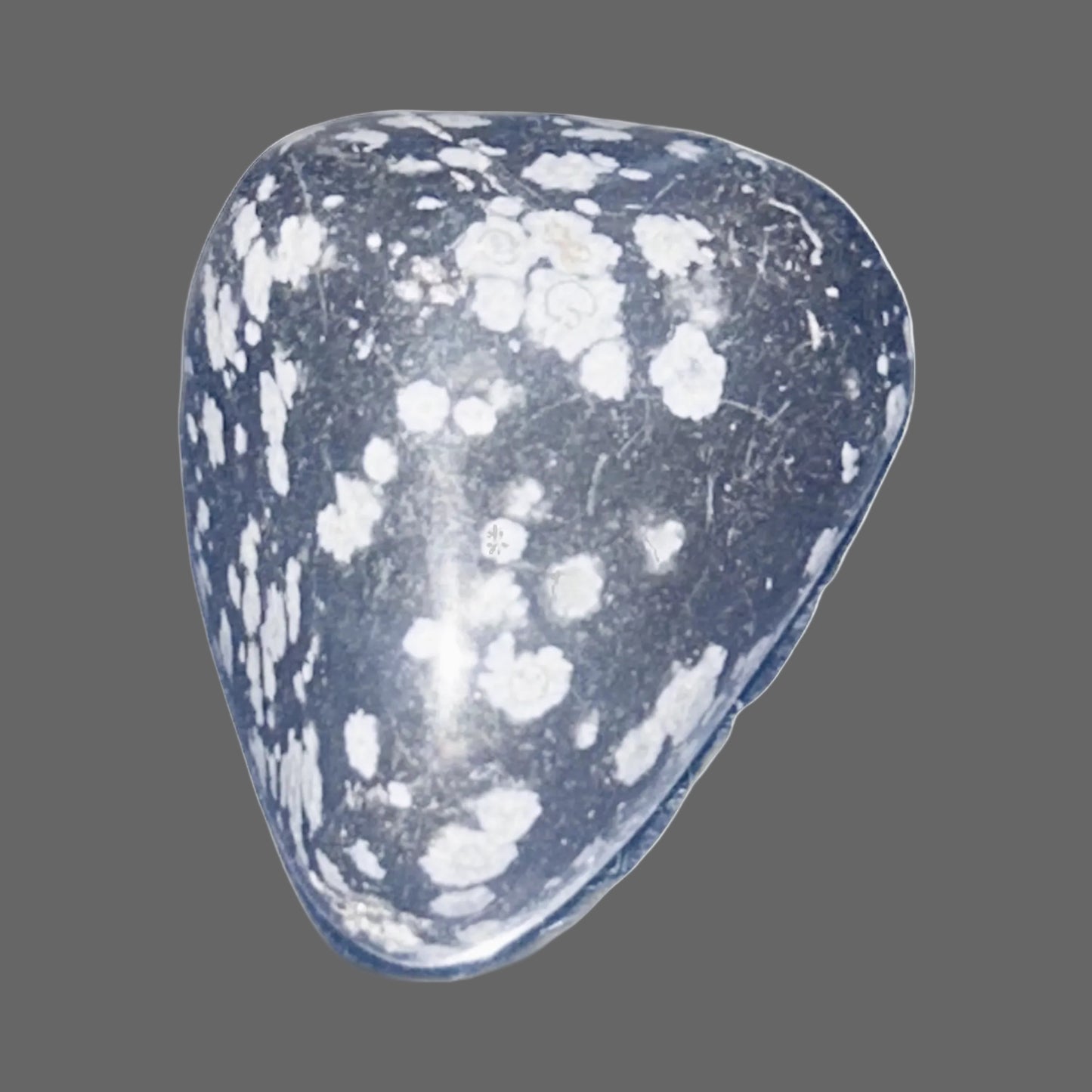
A snowflake obsidian specimen, 11g — inky black volcanic glass with soft gray-white cristobalite inclusions scattered across the surface in the characteristic snowflake pattern. Fire cooled into stillness, then slowly marked by frost.
WHAT WE KNOW
Snowflake obsidian is a variety of obsidian — naturally occurring volcanic glass — in which small white to gray spherulites of cristobalite (a high-temperature polymorph of quartz) have crystallized within the glassy matrix after formation. The cristobalite develops as the obsidian slowly devitrifies over time, producing the characteristic white or gray “snowflake” patterns against the black glass base. The contrast between the amorphous volcanic glass and the crystalline inclusions is the defining visual feature of the material. This specimen weighs 11g. Locality not independently verified.
THE STORY
Obsidian forms when silica-rich lava cools so rapidly that crystals cannot develop — the result is a natural glass rather than a crystalline rock. Snowflake obsidian represents a later stage in that process: after the glass has formed, slow devitrification allows cristobalite to nucleate and grow within the matrix, producing the white inclusions. It is, in a sense, a stone in the process of becoming something else — the glass slowly converting to crystal, caught partway through.
WHY WE CHOSE IT
The snowflake patterning on this piece is well-developed and clearly visible — the contrast between the black glass and the white inclusions is strong. At 11g it’s a compact specimen that works as a desk piece or a collection accent with a graphic, high-contrast visual presence.
ABOUT THIS PIECE
Type: Snowflake obsidian (volcanic glass with cristobalite inclusions)
Weight: 11g
Locality: Not independently verified
Condition: Natural specimen — please review photographs for patterning, contrast, and natural variation.
Quantity: 1 — one of a kind.
Share


Field Notes
Recovered and preserved as discovered.
Marks, textures, and imperfections remain untouched.