


Found in the Field
Green Fluorite Crystal — Translucent Natural Crystal, Cubic System, 153g — Field Find
Green Fluorite Crystal — Translucent Natural Crystal, Cubic System, 153g — Field Find
Couldn't load pickup availability
THE FIND
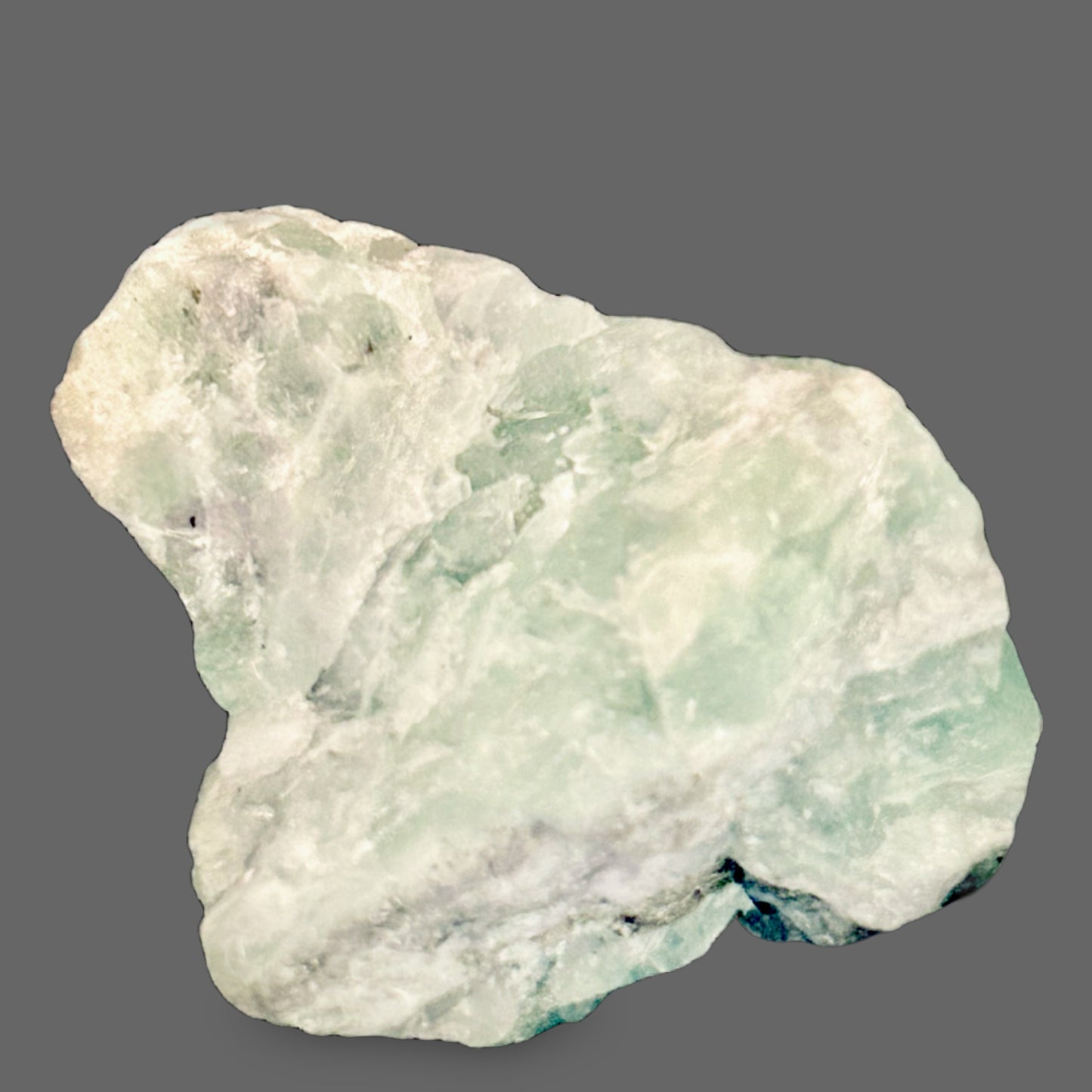
A green fluorite crystal, 153g — translucent natural mineral with the quiet geometry of cubic crystal growth. Green fluorite has a way of looking both solid and almost glass-like at the same time: light moves through the translucent areas while the crystal structure gives the specimen its geometric character. At 153g it has enough presence to stand out in a collection without losing the irregular character of a natural find.
WHAT WE KNOW
Fluorite (CaF₂) is a calcium fluoride mineral that crystallizes in the cubic system — one of the most geometrically regular crystal systems, producing the characteristic cube, octahedron, and cuboctahedron forms. It is one of the defining minerals on the Mohs hardness scale at Mohs 4, meaning it scratches with a steel knife but not a copper coin. Fluorite occurs in a wide range of colors — colorless, green, purple, blue, yellow, pink — with color produced by trace element substitution and lattice defects (color centers) caused by natural radiation exposure. Green fluorite typically derives its color from trace yttrium, rare earth elements, or radiation-induced color centers. Fluorite has an important historical footnote: the phenomenon of fluorescence — the emission of visible light when exposed to ultraviolet light — was first described and named by George Gabriel Stokes in 1852, and he named it after fluorite, which commonly fluoresces blue-violet under shortwave UV. Many fluorite specimens glow under UV light; whether this individual specimen does has not been confirmed. The exact geological locality has not been independently verified. This specimen weighs 153g.
THE STORY
Fluorite gave science the word “fluorescence.” When George Gabriel Stokes was trying to describe what happened to certain minerals under ultraviolet light in the 1850s, he reached for fluorite as his example — it glowed with a blue-violet light that the incoming radiation alone could not explain. The mineral became the name for the phenomenon. There is a satisfying tension in fluorite between precise cubic geometry and the imperfect shape of a natural specimen. The crystal system tends toward cubes; the earth rarely produces perfect ones. This piece preserves that character rather than being reduced to a perfectly uniform decorative object.
WHY WE CHOSE IT
The translucency and green color are both strong — fluorite’s glass-like quality is most apparent in transmitted light and this specimen has enough of that character to be worth displaying near a light source. At $20 it is one of the most accessible entry points in the collection. A strong introductory mineral specimen with more geological history than its price suggests.
ABOUT THIS PIECE
Type: Green fluorite crystal (calcium fluoride, cubic system — locality not independently verified; UV fluorescence not confirmed for this specimen)
Weight: 153g
Locality: Not independently verified
Condition: Natural crystal — please review photographs for color, translucency, crystal structure, and natural variation.
Quantity: 1 — one of a kind.
Share


Field Notes
Recovered and preserved as discovered.
Marks, textures, and imperfections remain untouched.