


Found in the Field
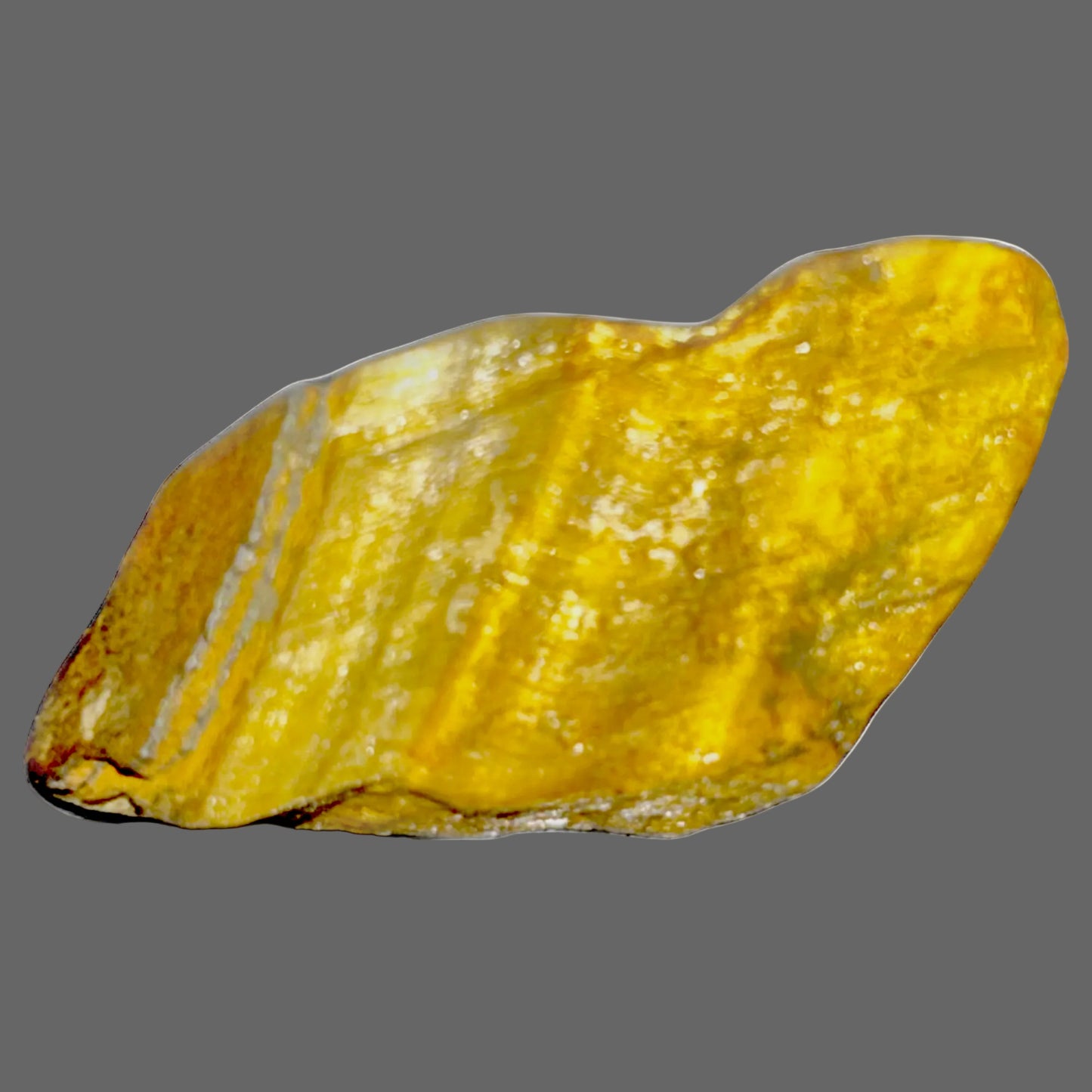
Tiger’s Eye Specimen — Golden Honey Bands, Chatoyant Shimmer, 17g — Field Find
Tiger’s Eye Specimen — Golden Honey Bands, Chatoyant Shimmer, 17g — Field Find
Couldn't load pickup availability
THE FIND
A tiger’s eye specimen, 17g — warm gold and deep honey bands with the silky chatoyant shimmer that moves across the surface as the stone shifts in light. Sunlight held beneath stone.
WHAT WE KNOW
Tiger’s eye is a chatoyant variety of quartz formed through pseudomorphic replacement: fibrous crocidolite (blue asbestos) is replaced by silica while the fibrous structure is preserved, producing the parallel fiber alignment responsible for the chatoyancy. The golden-brown coloration results from iron oxide within the preserved fiber structure. The chatoyant effect — the band of reflected light that moves across the surface as the viewing angle changes — is one of the most visually distinctive optical phenomena in mineralogy. This specimen weighs 17g and shows warm golden to honey-brown banding. Locality not independently verified.
THE STORY
Chatoyancy takes its name from the French for “cat’s eye” — the optical effect mimics the slit pupil of a cat reflecting light. In tiger’s eye, the effect is produced by the parallel alignment of microscopic silica fibers, each acting as a tiny reflector. The result is a stone that appears to have an internal light source that moves with the observer. The golden color register of this specimen — warm honey rather than the deeper brown of some tiger’s eye — makes the chatoyant band particularly visible against the lighter background.
WHY WE CHOSE IT
The chatoyancy on this piece is well-developed and the golden color register is warm and consistent. At 17g it’s a compact hand piece — slightly larger than our 11g tiger’s eye, with a warmer, more golden color profile. A strong desk or carry piece for anyone drawn to optical minerals.
ABOUT THIS PIECE
Type: Tiger’s eye (chatoyant quartz pseudomorph)
Weight: 17g
Locality: Not independently verified
Condition: Natural specimen — please review photographs for chatoyancy, banding, and natural variation.
Quantity: 1 — one of a kind.
Share


Field Notes
Recovered and preserved as discovered.
Marks, textures, and imperfections remain untouched.