


Found in the Field
Desert Rose — Natural Gypsum Crystal Rosette, Sand-Included, 34g — Field Find
Desert Rose — Natural Gypsum Crystal Rosette, Sand-Included, 34g — Field Find
Couldn't load pickup availability
THE FIND
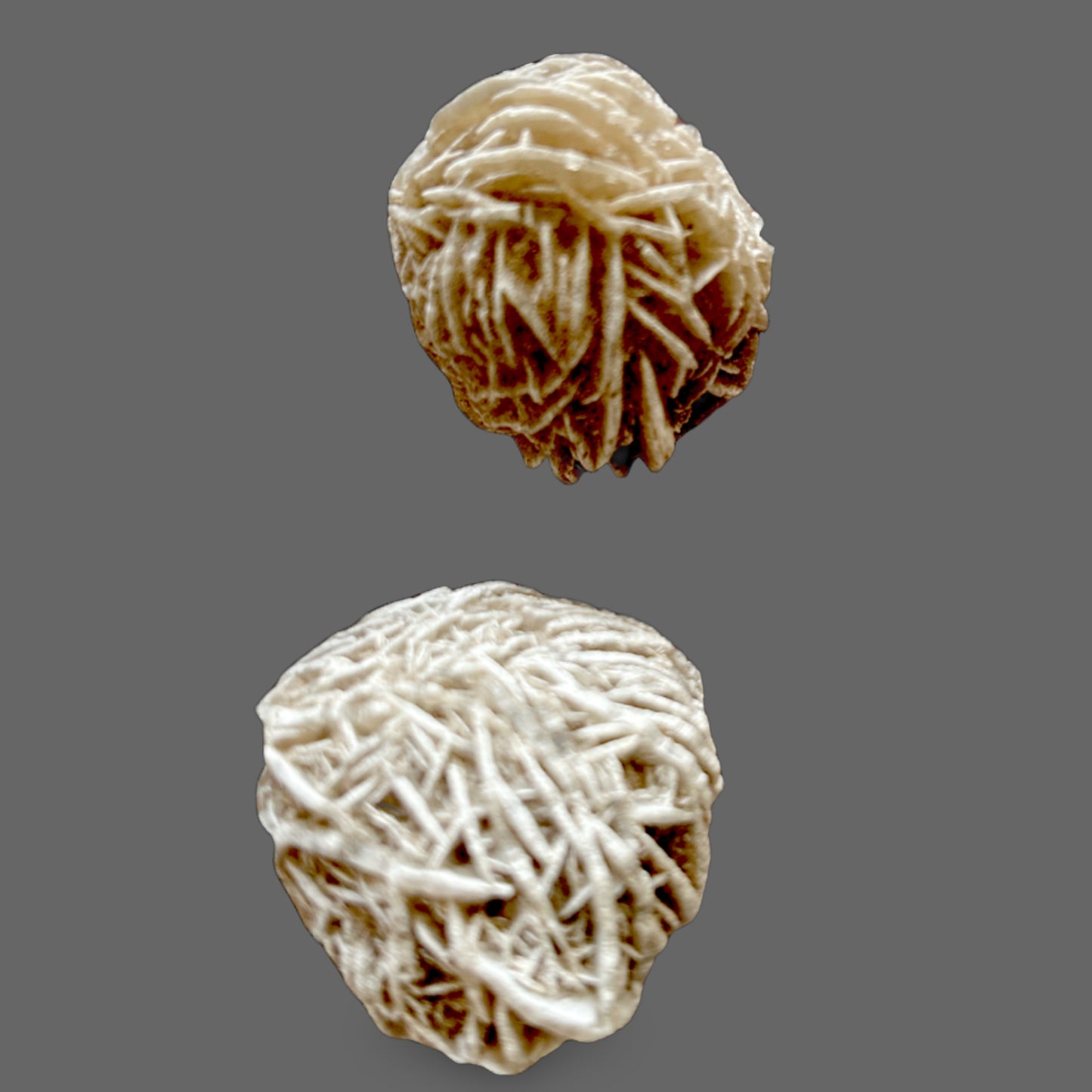
A desert rose, 34g — a natural gypsum crystal rosette shaped in an arid environment, flat crystal blades radiating outward from a central point with sand grains incorporated into the formation. It looks like a flower. It was never alive. That contradiction is part of the fascination: what resembles petals is the record of minerals crystallizing slowly under harsh, dry conditions, gathering sand into the structure as they grew. Mineral. Sand. Time. Together they create something that looks almost botanical while remaining unmistakably geological.
WHAT WE KNOW
Desert roses are rosette-shaped mineral aggregates that form through evaporite processes in arid or semi-arid sedimentary environments. Most are composed of gypsum (CaSO₄·2H₂O, calcium sulfate dihydrate), though barite desert roses also occur. Gypsum desert roses form when mineral-saturated groundwater or brine wicks upward through loose desert sediment by capillary action and then evaporates at or near the surface. As the water evaporates, dissolved calcium and sulfate ions precipitate as gypsum crystals. The crystals grow in a radiating, lenticular (lens-shaped) habit — flat blades that intersect and overlap to produce the rosette form. Sand grains present in the surrounding sediment become incorporated into the growing crystals during formation, giving desert roses their characteristic sandy texture and visible inclusions. The exact locality of this specimen has not been independently verified; the formation type is characteristic of desert environments in North Africa (particularly Algeria and Morocco), the American Southwest, and the Persian Gulf region. Gypsum is soft (Mohs 2) — handle with care. This specimen weighs 34g.
THE STORY
Nothing grows here, they said. But beneath the sand, the earth disagreed. Crystal gathered around crystal until a flower took shape — one that needed no rain, no sunlight, and no gardener. When the wind finally uncovered it, someone mistook it for a rose. Perhaps that was close enough. The sand inside the formation arrived before the crystal did — it was already there when the gypsum began to precipitate, and the growing crystal simply enclosed it. The flower and the desert are inseparable.
WHY WE CHOSE IT
The rosette structure is well-developed and the sand inclusions are visible. At 34g it is a small specimen with a large geological story — the most accessible entry point in the Found in the Field catalog at $10. A natural gift specimen, a desk curiosity, or the starting point for a collection.
ABOUT THIS PIECE
Type: Desert rose (gypsum crystal rosette with sand inclusions; locality not independently verified)
Weight: 34g
Hardness: Mohs 2 — handle with care
Locality: Not independently verified (formation type associated with North African and American Southwest desert environments)
Condition: Natural formation — please review photographs for rosette structure, sand inclusions, and natural variation.
Quantity: 1 — one of a kind.
Share


Field Notes
Recovered and preserved as discovered.
Marks, textures, and imperfections remain untouched.