


Found in the Field
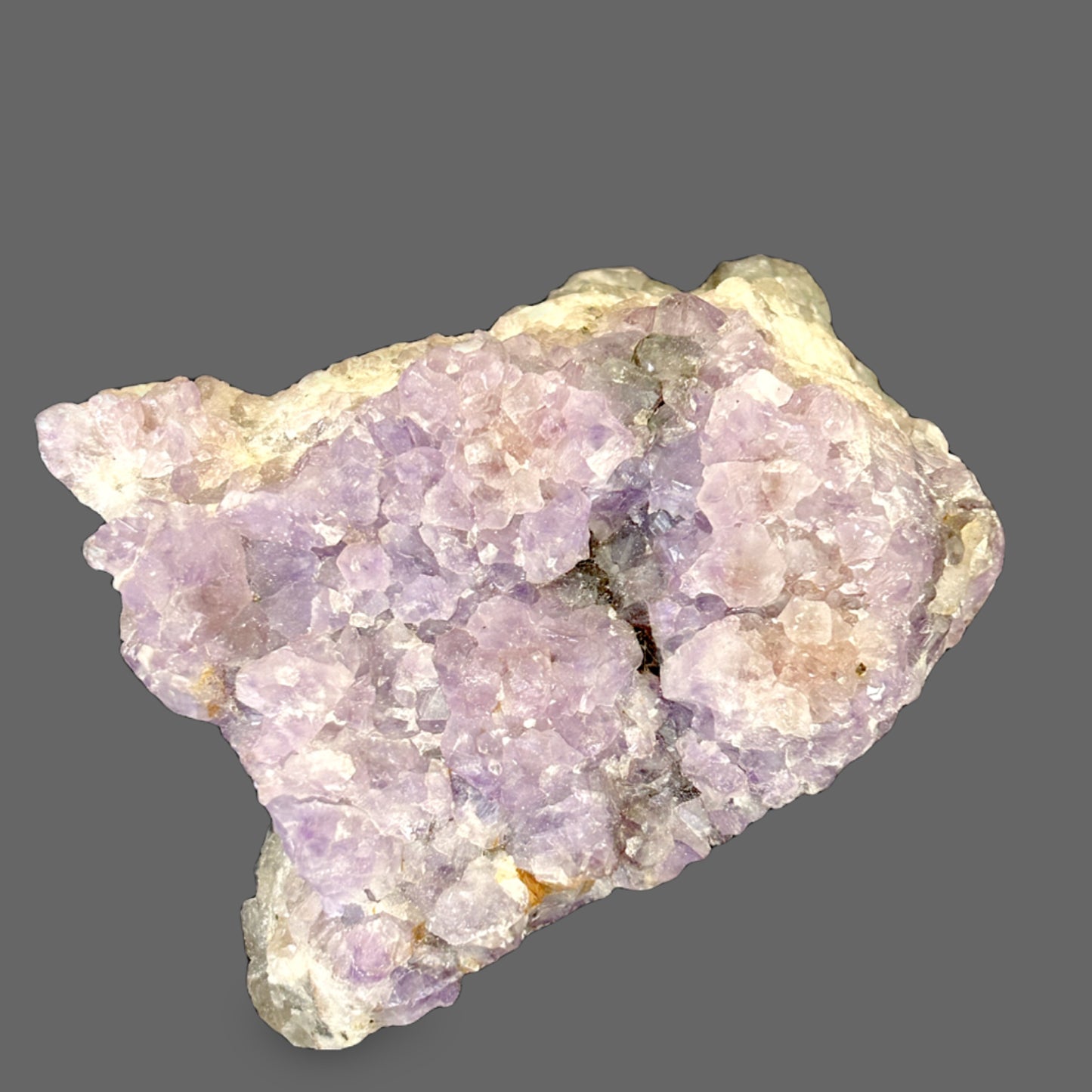
Amethyst Crystal Cluster — Violet Quartz Points, Natural Formation, 894g (1.97 lb) — Field Find
Amethyst Crystal Cluster — Violet Quartz Points, Natural Formation, 894g (1.97 lb) — Field Find
Couldn't load pickup availability
THE FIND
A natural amethyst crystal cluster, 894g (1.97 lb) — violet quartz points in natural formation, each termination catching light differently, no two points exactly alike. At nearly two pounds this is a true display piece: the scale gives it a different character from smaller amethyst specimens. A miniature crystalline landscape that preserves a record of slow growth long before it ever reached a collection.
WHAT WE KNOW
Amethyst is the purple to violet variety of quartz (SiO₂). The characteristic color is produced by iron (Fe³⁺) impurities within the quartz crystal lattice combined with natural irradiation from surrounding rock — the iron absorbs visible light in a way that produces the violet color. Heating amethyst above approximately 470°C converts the color to yellow-orange (the process that produces most commercial citrine), which confirms that the color is iron-related and thermally sensitive. Amethyst crystals grow in cavities within volcanic rock — most commonly basalt geodes — where silica-rich hydrothermal fluids slowly deposit quartz. In a cluster, multiple crystals grow simultaneously on a matrix, each competing for space and silica, producing the grouped-point form. The largest amethyst deposits are in Brazil (Rio Grande do Sul) and Uruguay, where basalt flows contain enormous geode cavities lined with amethyst. The exact geological locality of this specimen has not been independently verified. Weight: 894g / 1.97 lb.
THE STORY
There are places beneath the earth where time seems to stop. No wind reaches them. No sunlight. No footsteps. Only mineral-rich water moving slowly through stone, carrying iron and silica in solution. Crystal by crystal, the chamber fills. The violet color develops as iron becomes incorporated into the growing quartz lattice and natural radiation from the surrounding rock alters its oxidation state. When the earth finally gives one of those chambers back, what emerges can look less like a rock than a memory of a place no one was meant to see. Each point in this cluster grew in a different direction, reached a different size, developed a slightly different depth of color. Together they are a record of that hidden chamber.
WHY WE CHOSE IT
The scale is the argument. At 894g amethyst clusters are common; at this size they become anchor pieces — the kind of specimen you notice when you walk into a room. The natural formation and point development justify the display weight. A strong entry point for a serious mineral collection or a statement piece for a space that already has one.
ABOUT THIS PIECE
Type: Natural amethyst crystal cluster (purple quartz — iron/irradiation coloration; locality not independently verified)
Weight: 894g / 1.97 lb
Locality: Not independently verified
Condition: Natural crystal cluster — please review photographs for crystal points, terminations, color, and natural variation.
Quantity: 1 — one of a kind.
Share


Field Notes
Recovered and preserved as discovered.
Marks, textures, and imperfections remain untouched.